
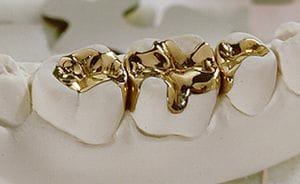
It is usually only when they experience pain or develop large cavities that most people take the often-unpopular step of visiting the dentist.
However, even the smallest hole in a tooth or a chipped corner should be repaired to prevent further damage to the tooth. If the damage to the tooth is still within certain limits and there is enough tooth structure remaining, a filling is the best solution.
The goal is to restore both the full functionality of the teeth and their natural shape and appearance.
The different types of filling
There is a wide range of different filling materials, which vary in terms of both functionality and cost. The right choice of material depends on the size and location of the defect, as well as on the specific situation and the individual’s preferences. That is why we always discuss these options with our patients on a case-by-case basis. We’re happy to assist you with advice and support!
Our practice specializes in metal-free fillings, and here we would like to provide you with a brief overview of the three most common types of fillings.
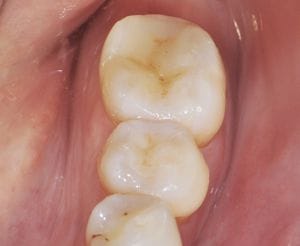
Ceramic Fillings—The Closest Thing to Nature
Ceramic fillings, also known as ceramic inlays, are superior to all other filling materials. Unlike other fillings, which are processed directly in the mouth while still malleable—that is, while they are still soft—they are fabricated with precision and a perfect fit in a dental laboratory after an impression is taken.
They have several advantages:
- They do not change in the mouth and remain stable over time:
As long as the tooth doesn't develop new decay elsewhere or the filling didn't fit properly from the start, the filling itself can last indefinitely. In fact, there are many cases where inlays, with good oral hygiene, still look as good as new even after 30 years!
- The hardness is equivalent to that of a natural tooth:
This ensures a similar level of abrasion—that is, wear on the tooth and the filling—and the chewing force is comparable to that of a natural tooth. As a result, even large fillings or entire cusps, such as partial crowns, can be replaced with inlays.
- More affordable thanks to its long shelf life:
Although the cost is higher than that of other fillings due to the complex manufacturing process, their long durability makes them more cost-effective over time.
- Ceramic inlays are perfect replicas of nature:
They are a type of artificial tooth enamel and meet the highest standards in terms of aesthetics and natural-looking shape. The result: even at close range, these inlays cannot be distinguished as such.
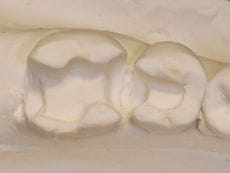
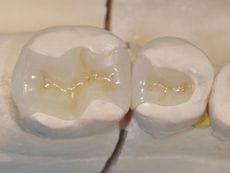
For this reason, ceramic inlays are the method of choice for us today when esthetics and durability are important.
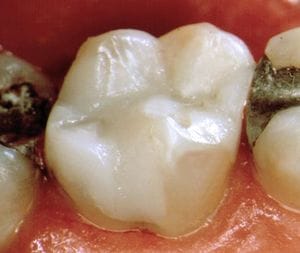
Plastic fillings - beautiful and affordable
For aesthetic reasons and because it is less expensive than porcelain, tooth-colored plastic—also known as a composite filling—is now the most commonly used filling material.
Due to its good esthetics, resin is the material of choice, especially in the anterior region. It is also a tried and tested standard material for smaller fillings.
This seems to resolve the issue of finding a filling material to replace amalgam—at least for now. However, composite fillings come with their own set of problems:
- On average, a filling needs to be replaced after three to six years:
A medium-sized plastic filling in the posterior region that is subjected to chewing forces will typically start to leak again during this period and must be replaced. In this case, a little more healthy tooth structure must be removed, so that the filling gets larger each time and the problem becomes increasingly severe.
- All dental resins are placed in the tooth while still soft and undergo some shrinkage as they harden:
The larger the filling, the more material is used and the greater the shrinkage. For this reason, the filling material is applied to the tooth in several layers to minimize this shrinkage as much as possible. However, it can rarely be avoided entirely, which can lead to stress in the tooth, pain when biting down, and sensitivity. Micro-gaps can also form between the filling and the tooth. This can lead to leaking margins and secondary caries—that is, new decay under the filling.
- Composite fillings are less resistant to wear than other materials:
Despite containing modern ingredients such as glass or ceramic particles as volume fillers, they do not provide the necessary resistance to chewing forces because the material is softer than tooth structure. In the case of large fillings, this leads to rapid wear and changes in the bite.
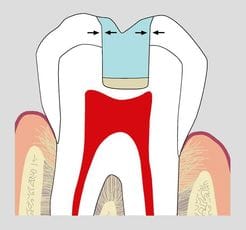
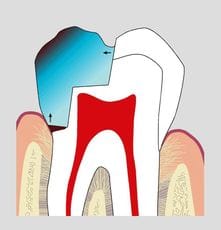
For some patients, the ingredients may also pose a problem in terms of intolerances and allergies. However, this can be checked in advance.
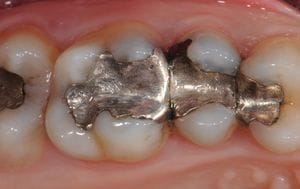
Fillings with amalgam - curse or blessing?
Even today, millions of teeth worldwide still have amalgam fillings. These consist of a mixture of approximately 60 % silver, 40 % mercury, and various other heavy metals such as copper and tin.
Like all plastic filling materials that are placed in the tooth in a soft state and harden only after being placed there, amalgam is not stable over the long term but undergoes various changes in the mouth. In the case of amalgam, corrosion is a major concern, as it can lead to leaking filling margins, the invasion of bacteria, and, as a result, new cavities.
The fracturing of entire tooth walls or cusps due to stress within the tooth is also quite common. Nevertheless, with an average lifespan of 9–20 years (and in some cases up to 30 years), it still has the longest durability compared to other restorative materials, such as plastics.
Due to the health concerns about its ingredient mercury, amalgam only plays a minor role and is therefore no longer used in our practice!
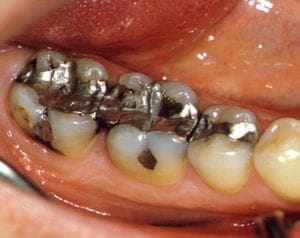
People who have multiple metals in their mouths—such as gold and amalgam—are particularly likely to have elevated mercury levels in their bodies. Electrochemical corrosion, known as the “battery effect” in the mouth, can cause mercury ions to be released from the amalgam. Through the wear and tear of the teeth during normal function—known as abrasion—not only mercury but also other heavy metals such as copper or tin enter the body and are deposited primarily in fatty and nervous tissue. There, they can exert their neurotoxic effects.
Depending on a person’s physical condition or the level of exposure, amalgam can eventually trigger a wide range of chronic and nearly imperceptible secondary conditions. These include, among others:
- Allergies,
- Weak defense,
- Anemia,
- Depression,
- Asthma,
- Headaches,
- Anxiety disorders,
- Intestinal diseases,
- Skin eczema,
- Atopic dermatitis,
- Memory problems,
- Joint pain,
- Heart rhythm disorders,
- Liver and kidney damage.
To ensure an accurate diagnosis, we therefore offer—in collaboration with our medical partners—a test to assess heavy metal exposure in the mouth and body, as well as heavy metal detoxification following amalgam removal.
Dr. Jens Tartsch
More on Fillings
This guide compares composite and ceramic inlays and explains how to choose the right filling material.
 German
  English
  German (Switzerland)
  Italian
  French