
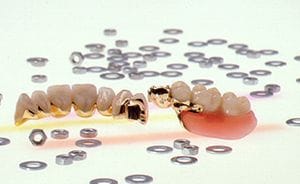
Dental prosthetics are necessary whenever missing teeth or teeth that cannot be preserved need to be replaced, or when heavily filled and decayed teeth cannot be permanently preserved through conservative treatment methods such as fillings. These include crowns, bridges, and removable or fixed dentures.
Dental Prosthetics – Various Options for a Complete and Natural Smile
There are many paths to achieving your goal, and before treatment begins, we’ll provide you with detailed advice on the various options we can offer. You’ll then decide on the treatment plan that’s best for you personally.
You have the following options:
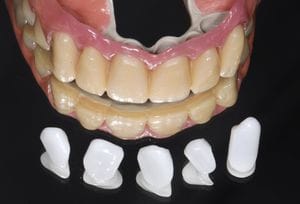
Metal-free dental prostheses made from the high-performance plastic PEEK
Our practice specializes in metal-free dental restorations. In implantology, polyetheretherketone—or PEEK for short—has been used as a spinal implant for over 10 years. Today, PEEK is also used in dentistry and offers excellent material properties:
- no metal
- Hardly any wear
- No corrosion
- Very good stability
- low weight
- High elasticity
PEEK is used as the framework instead of the metal that is typically used. The tooth-colored veneers and the pink denture base are fabricated using standard or specially selected resins, depending on sensitivity and individual tolerance.
Dentures made of PEEK can be worn like natural, fixed teeth with zirconia ceramic telescopes and need only be briefly removed in the morning and evening when brushing your teeth.
Dr. Jens Tartsch
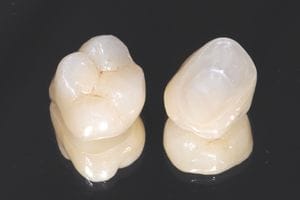
Fixed all-ceramic crowns
If the tooth structure has been damaged too severely by cavities or root canal treatments, it is no longer possible to preserve the tooth long-term with fillings alone. When the long-term prognosis is favorable, crowns can be used to protect and replace the tooth structure of individual teeth.
The tooth is prepared. An impression is then taken and cast in special plaster. Depending on the aesthetic requirements, the dental laboratory uses this impression to fabricate the crowns, with or without metal (gold alloys).
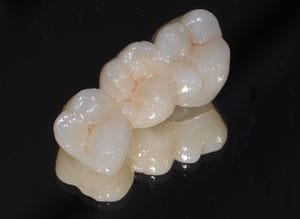
Fixed all-ceramic bridges
If one or more teeth are missing from a row of teeth and the patient prefers a fixed dental restoration, a bridge is an alternative to implants. This is especially true when there is insufficient bone for implants or when the adjacent teeth already have old crowns.
A bridge can be used to close a gap by using the teeth adjacent to the gap as abutment teeth. These abutment teeth are prepared, and the missing teeth are connected to the abutment crowns via bridge pontics.
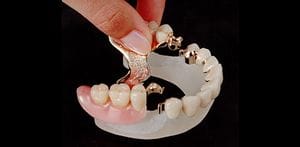
Partial dentures
If one or more teeth are missing from a jaw, they can be replaced with a removable partial denture as a non-surgical alternative to implants.
The components are:
- replacement teeth made of plastic or ceramic
- the base made of tooth-colored plastic and/or steel
- the anchoring or retaining elements used to secure the denture to the natural teeth—such as clasps, attachments, or telescopic clasps—which affect wearing comfort and the resulting quality of life.
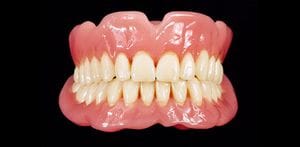
Complete dentures
If all the teeth in one jaw have been lost, the only solution—aside from dental implants—is a full denture.
Ideally, a full denture stays in place on the jaw through suction, much like a suction cup. Although one might assume that gravity would make it more difficult to provide a sufficient hold for an upper denture, the opposite is true.
Dentures in the upper jaw usually fit well, while those in the lower jaw tend to fit less well due to the smaller contact surface and the tongue's considerable mobility.
More on Dental Prosthetics
This guide compares metal-free crowns, bridges, and dentures and explains which solution is appropriate for which situation.
 German
  English
  German (Switzerland)
  Italian
  French