
An implant does more than just replace a tooth. It also plays a key role in determining how well your body accepts the new tooth root. This is precisely where our practice places a special emphasis.
A dental implant is an artificial tooth root that is firmly anchored in the jawbone and fuses with it. It permanently replaces a missing tooth without requiring healthy adjacent teeth to be ground down, as would be necessary with a bridge. That’s the textbook definition. In practice, however, there’s a question that’s often overlooked: What material should the new root be made of, and how well will your body tolerate that material over the course of decades?
At Dr. Jens Tartsch’s dental practice in Kilchberg, we approach implantology from a holistic perspective that considers the entire body. As a practice specializing in environmental dentistry, we ensure that dental restorations place as little strain on the immune system as possible. That is why we focus on metal-free ceramic implants, supplemented by proven titanium implants where they are the more appropriate solution.
Ceramic or Titanium: The Real Difference
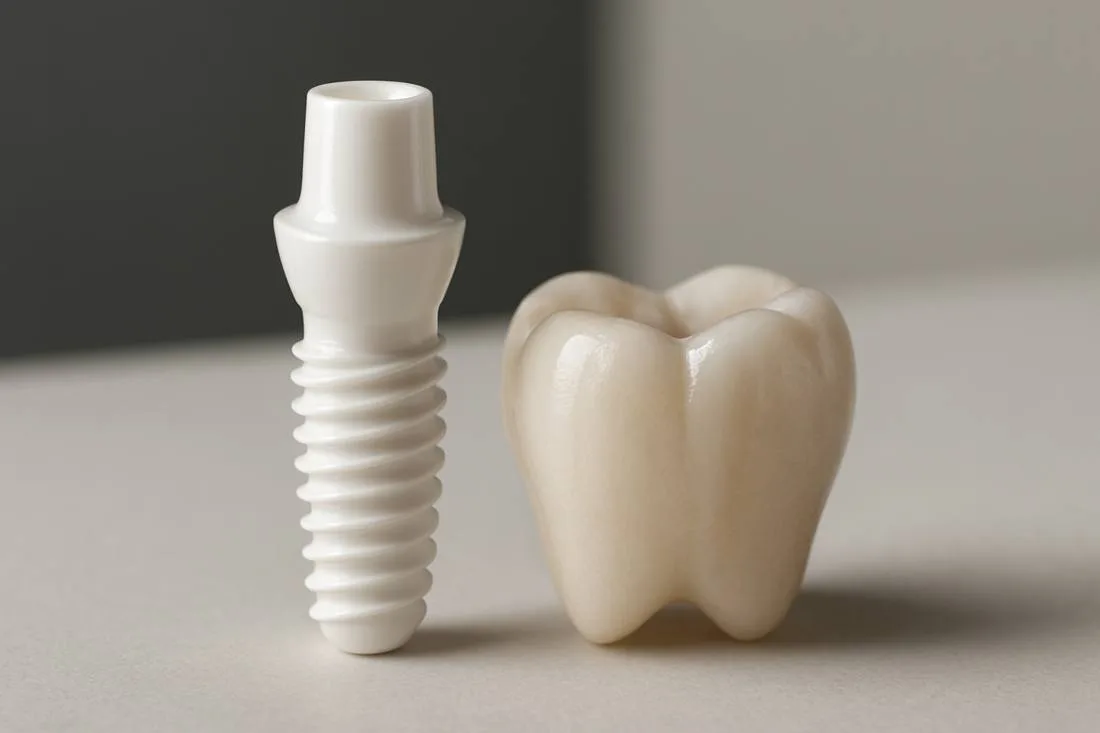
Both materials have been tried and tested for many years, and both can produce excellent results. The difference lies less in durability than in tolerability and the patient's specific needs.
Ceramic (zirconia)
- Completely metal-free
- High biocompatibility and low bacterial biofouling
- No dark line along the gumline; light and natural-looking
- Ideal for health-conscious patients
Titanium
- A proven standard for decades
- Very sturdy and durable
- A wide range of options for future dental prostheses
- Appropriate when it is the best medical solution
Ceramic implants: metal-free and highly biocompatible
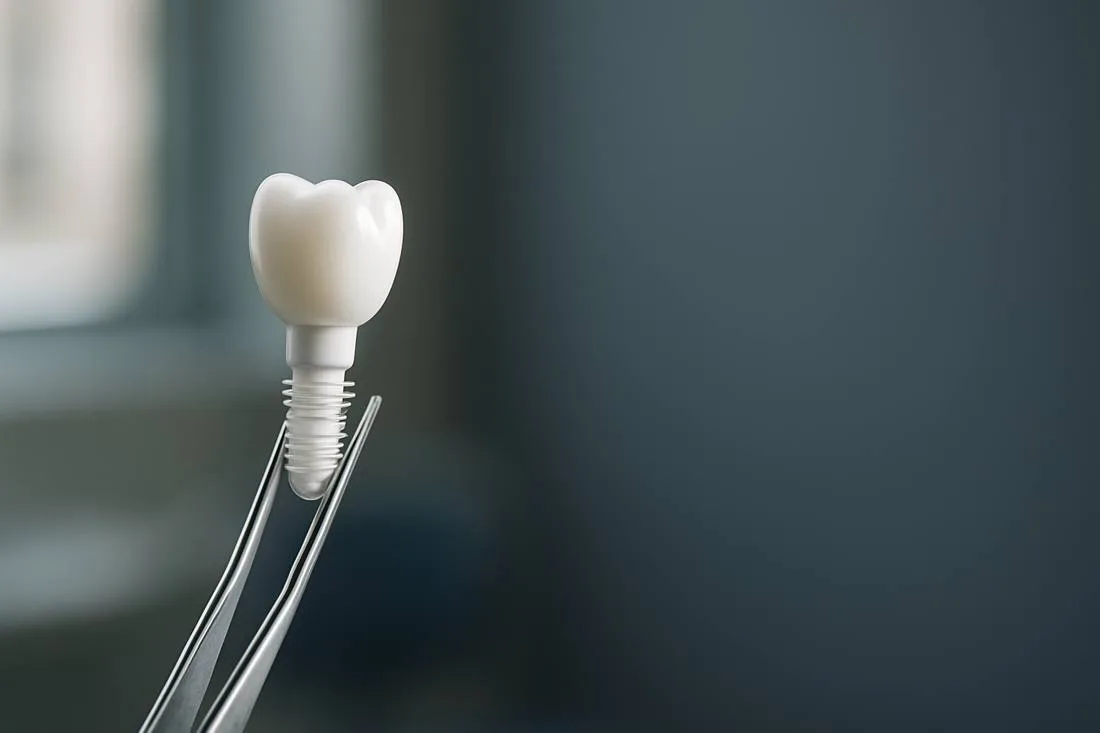
Ceramic implants are made of zirconia, a high-strength, white ceramic. They are completely metal-free. We rule out biocorrosion with this material, unlike with titanium. We value the biocompatibility of zirconia and the minimal bacterial buildup on its surface. For health-conscious individuals who prioritize body-friendly dental restorations, they are the obvious choice. Another advantage is visible: Because ceramic is light in color, no dark line shows through at the gum line. The result looks natural. Today, modern high-performance ceramics achieve success rates averaging 97 percent after five years, putting them on par with titanium.
Titanium Implants: The Proven Standard
Titanium implants They have the longest track record of long-term use and are considered the established standard in implantology. It is very stable, durable, and heals reliably. However, recent research shows that even titanium can corrode and release fine particles, which in isolated cases can lead to titanium intolerance in the form of an exaggerated foreign body reaction. If necessary, we’ll determine in advance whether such a tendency exists by conducting a titanium stimulation test. Where a titanium implant is medically the most sensible solution, we’ll advise you openly and honestly.
Are implants suitable for everyone?
Not every gap between teeth can automatically be filled with an implant. Whether an implant is an option for you depends on whether you have enough jawbone of suitable quality and on your overall health. The Requirements for Implants We assess each case individually. That's why we always start with a thorough examination and a consultation, during which we work with you to find the best solution.
When an Implant Is a Good Option
- Single-tooth gap: The implant stands on its own; healthy adjacent teeth remain unaffected.
- Multiple missing teeth: with a fixed bridge supported by implants.
- Edentulous Jaw: with fixed dentures supported by several strategically placed implants.
Single-tooth gaps, missing back teeth, and edentulous jaws are listed on the Page on Areas of Application explained in more detail.
How Implant Treatment Works
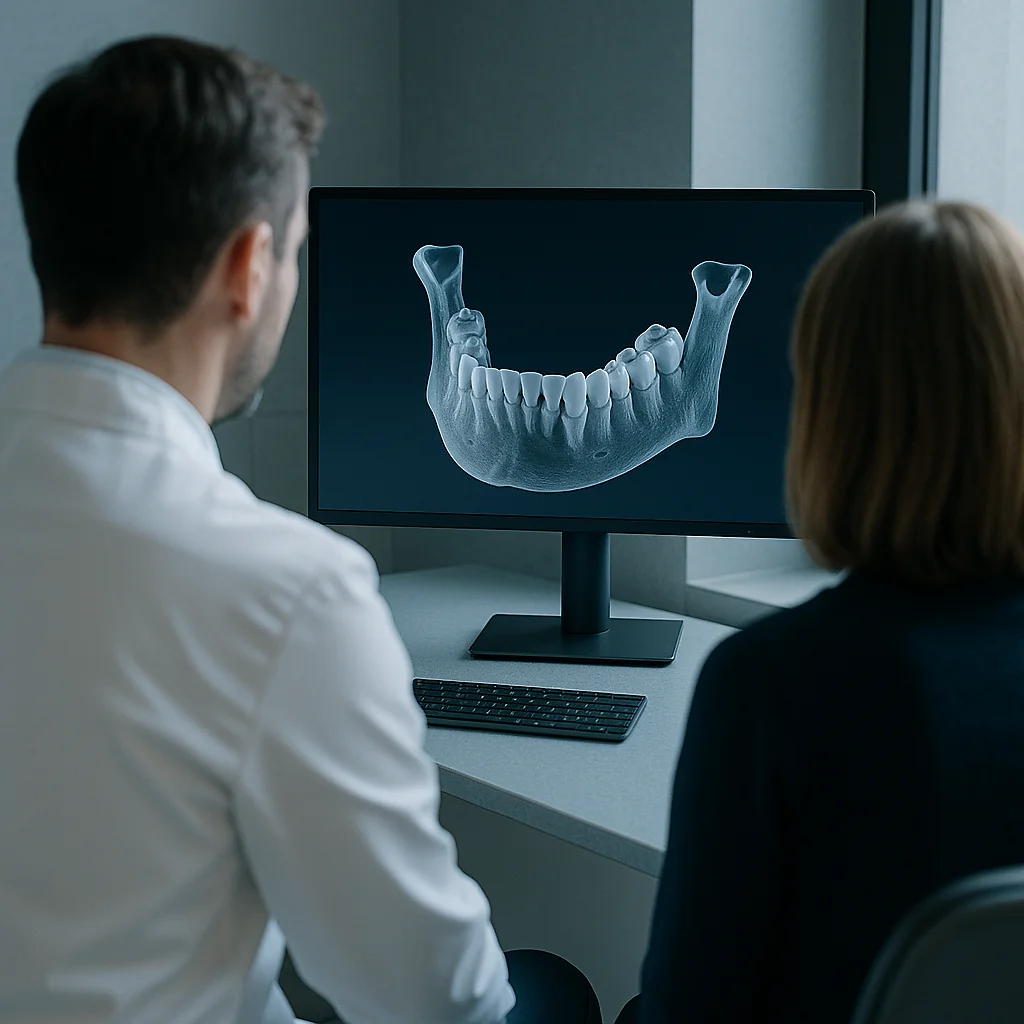
First, we take the time to explain the procedure to you and work with you to plan the appropriate treatment. This is followed by the placement of the implant under local anesthesia, the healing process within the bone, and the placement of a crown after an impression is taken and the crown is fabricated in the lab. The four steps below outline the general procedure.
You can read more about the treatment steps—from the initial consultation to the crown—on our Page on the Implant Procedure.
When the bone is insufficient
Not every jawbone provides enough bone for an implant right from the start. In such cases, we use a Bone Grafting (Augmentation) First, create a stable foundation by filling in the missing area and protecting it with a collagen membrane.
Our Approach to Implantology
For us, an implant is not an isolated procedure, but part of a larger picture. As a practice specializing in environmental dentistry—an approach that Dr. Tartsch also helps shape in his role as chairman of the German Society for Environmental Dentistry—we combine modern technology, computer-aided planning, and minimally invasive methods with a holistic view of your health. We take the time to explain every step to you and create a calm atmosphere where you feel well cared for. This approach defines our entire practice, from preventive care to implantology.
Dr. Jens Tartsch's Practice, Kilchberg
About fifteen minutes from Zurich Central Station and right next to the Kilchberg train station. If you have any questions about dentures or ceramic implants, we’d be happy to discuss them with you in person.


 German
 English
 Italian
 French