
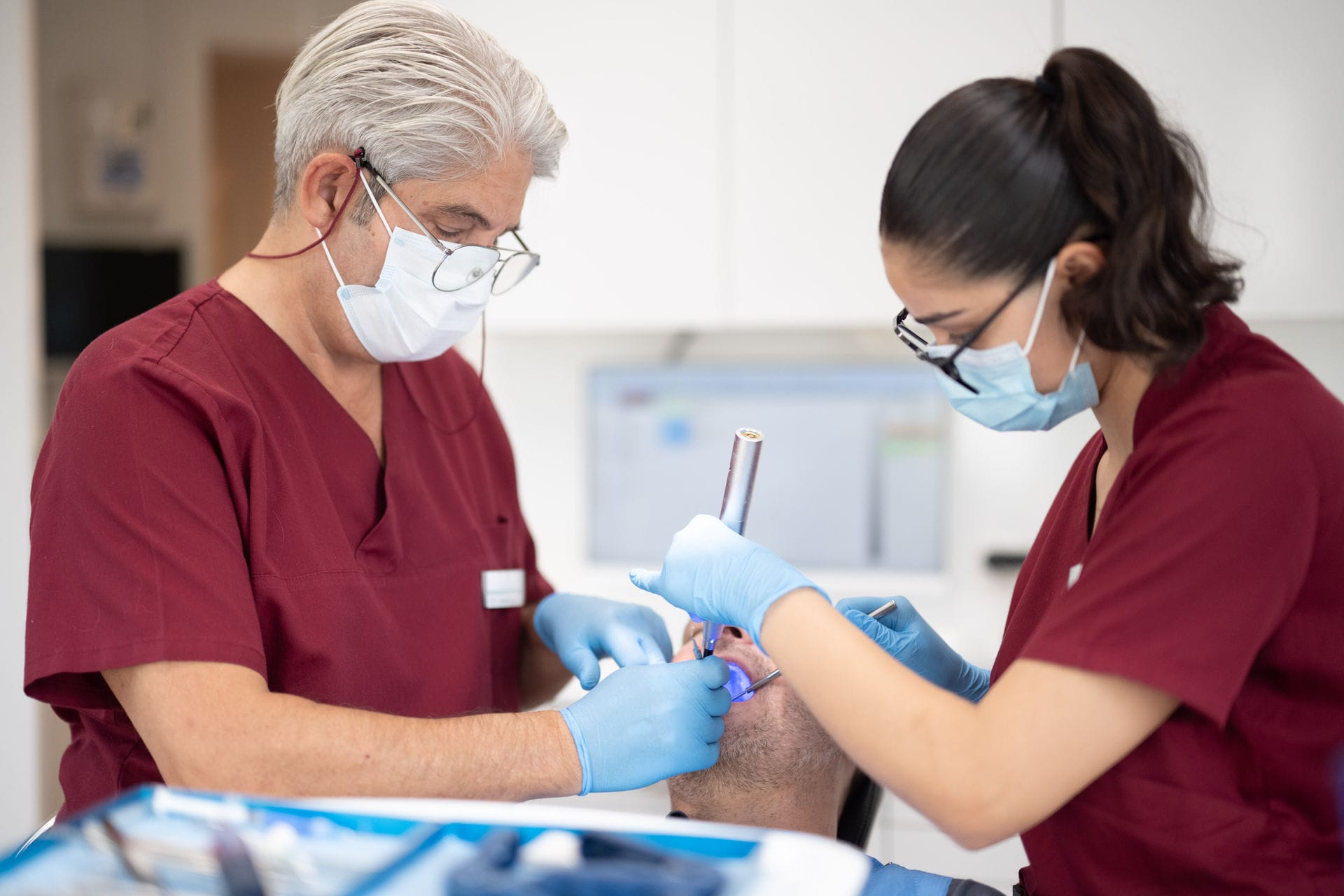
Are you afraid of the dentist, the drill, and the noises? Does the mere thought of a trip to the dentist make you break out in a sweat?
Don't worry—you're not alone! Millions of people feel exactly the same way you do! So you already know this: Your anxiety is completely normal. We know that, too, so there's absolutely no reason to hide your anxiety and fears—or to be ashamed of them.
Fear of the Dentist

Some studies suggest that the surge of adrenaline in the body during a visit to the dentist is equivalent to that experienced during a skydive. Some people are avid skydivers, but not everyone can handle free fall or remain calm during it.
Where does this fear come from? And what can be done about it?
Our practice specializes in offering solutions for those who are afraid of the dentist, including:

Treatment Under Hypnosis
Many people are familiar with hypnosis from television programs or shows in which a show hypnotist makes seemingly unwilling people carry out embarrassing commands.
Medical hypnosis, or hypnotherapy, has absolutely nothing to do with this and follows entirely different principles! Medical hypnosis will help you achieve your goal of anxiety-free, relaxed, and painless dental treatment.
This is only possible through cooperation; it is never done against the patient's will! You remain in control at all times, are aware of everything happening around you, and can stop the procedure on your own at any time! You will feel comfortable throughout the process.
What does hypnosis feel like?
All patients can benefit from hypnosis at the dentist because it makes the treatment feel faster and more comfortable. How does that work?
- With hypnosis, you can go to the dentist and, during the treatment, feel as if you were on vacation or in some other pleasant place.
- It's as if you've lost track of time and space. Who hasn't been driving on the highway and suddenly wondered how they covered those last few kilometers?
- It's as if you just can't remember. Who hasn't been reading a good book and had to flip back a few pages because they couldn't remember what happened on the previous pages?
These are the same trance states that hypnosis aims to induce.
The Goal of Dental Hypnosis
One goal of dental hypnosis is for you to feel well-rested and relaxed after a long dental appointment. For patients who rarely visit the dentist due to extreme anxiety, hypnosis significantly reduces—or even completely eliminates—their fear. Only then is it possible to provide anxious patients with relaxed and thorough dental treatment.
Hypnosis can also help people who grind or clench their teeth or have temporomandibular joint (TMJ) problems, as well as patients with chronic headaches or nausea.

Treatment under general anesthesia
For many patients with extreme anxiety, anesthesia is a blessing. They fall asleep feeling relaxed, which allows us to provide optimal dental and technical care.
After the procedure, you will slowly wake up from the anesthesia. Pain medication administered while you are still under anesthesia will largely prevent pain and swelling. Dental treatment is usually completed after one or two appointments under anesthesia. Fortunately, in almost all cases, you’ll then be able to attend follow-up appointments without much difficulty.
How is general anesthesia administered?
Careful planning and seamless coordination between the anesthesiologist, dentist, and dental technician are essential for these appointments. We take care of everything.
Anesthesia is administered by an experienced anesthesiologist on our team, in accordance with the latest medical findings and the highest safety standards. The duration of anesthesia can easily be extended to several hours, allowing patients to significantly reduce the number of dental visits, even for lengthy and complex treatments.
The Risks of Anesthesia
The risk of anesthesia in healthy patients is very low these days. This is due to advances in new anesthetics, which ensure better tolerability for the patient, faster elimination from the body, and fewer side effects.
However, a residual risk remains. For this reason, we offer anesthesia only to select patients upon special request. In addition, health insurance companies generally do not cover the costs associated with this procedure in the field of dentistry.
Helpful Tips for Patients with Anxiety

Here's some good news to start with: Just by reading this, you've already taken the first step toward overcoming your fear!
If you already suffer from a phobia or a fear of dental treatment, you probably won't know where to start in overcoming the problem.
That's why we've put together a few tips for you:
Try to assess your anxiety realistically
The simple thought of going to the dentist can cause you extreme anxiety. This could make it difficult for you to assess your situation objectively.
Accept the fear
Wait and give your fear some time; don't run away from it, but talk openly with us about it. Learn more about your fear. If you've waited for years, a few more weeks won't make much difference now.
Talk to those affected
There are self-help groups and forums where helpful people can support you in overcoming anxiety. People who have been or are still in your situation will be able to help you better than those who only know about this fear from hearsay. However, we also experience it on a daily basis when dealing with our patients. So we know what you are talking about and take you seriously!
Take as much time as you need
We’ll take the time for you, too! If you’ve been waiting for years, a few more days won’t make much difference now. Right now, the most important thing for you isn’t getting your teeth fixed, but overcoming your fear. However, don’t let it get to the point of acute pain or inflammation. In those cases, for the sake of your health, you must see a dentist or go to an emergency dental clinic immediately.
Prepare yourself
Get used to the situation. First, we'll schedule an introductory appointment with you. No treatment will take place during this appointment; we'll just have a detailed conversation.
Distract yourself
Try not to focus only on the negative and not to let speculation fuel your anxiety; instead, be proud that you’ve taken the first step. You can also distract yourself with music or reading. We’ll be offering you some options in this regard.
Consult a psychologist
However, if you still don't have the confidence to go to the dentist, you can consider contacting a psychologist or psychotherapist. They can pave the way for dental treatment and possibly provide support.
Find a place to relax with us! We're the mountain guide who'll lead you up the mountain you wouldn't want to climb alone!
Dr. Jens Tartsch
More on the Topic of Dental Anxiety
This guide describes hypnosis and empathetic care, and explains how to successfully return to dental treatment.
 German
  English
  German (Switzerland)
  Italian
  French