

Laser dentistry
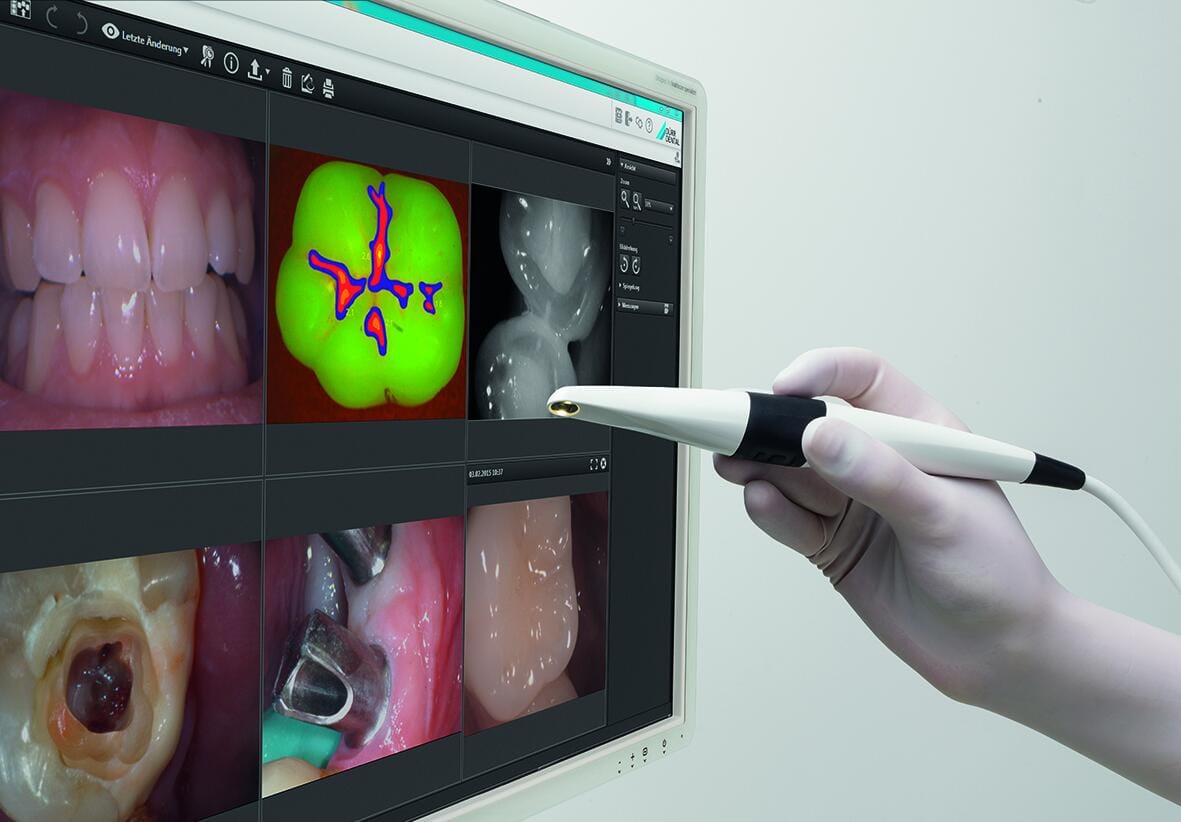
The «laser» has now become an integral part of modern medicine. It has also been used in dentistry for 30 years.
However, it is only in recent years that laser technology for dentistry has been refined to the point where it has become established as a modern treatment method in daily practice. However, despite misleading reports in the media, its best-known application—laser «drilling»—is unfortunately still so much in its infancy that this area serves more as a marketing gimmick than a practical solution.
However, with the help of lasers, many treatments in our practice are already painless, quick and particularly gentle.
Areas of application
- Periodontology (gum treatments)
Thanks to the bacteria-killing (decontaminating) effect of the laser beam, treatment can often be performed without any surgery at all. After removing tartar and plaque, the thin laser probe is inserted all the way to the bottom of the gum pocket colonized by bacteria. There, the laser beam eliminates the aggressive periodontitis-causing bacteria, thereby creating the conditions necessary for the gum disease to heal. Scientific studies have shown that laser therapy significantly improves the chances of recovery from periodontitis.
- Root canal treatments
Here too, the laser beam helps to reduce and kill germs in the root canal. This makes root canal treatment faster and significantly safer.
- Surgery
With the help of lasers, many operations are possible without a scalpel, without injections, without bleeding, sutures and after-effects.
- Other areas of application
General pain conditions, canker sores/cold sores, hypersensitive tooth necks, support for wound healing, disinfection, implantology, bleaching of individual teeth, and much more.


In a nutshell
What do we use the laser for?
We use the laser for a variety of procedures, including gum treatments, root canal treatments, and certain surgical procedures. There are also other potential applications, such as to promote wound healing or to treat hypersensitive tooth necks. We will discuss with you which of these options is appropriate for your condition and what role the laser plays in that treatment.
Can lasers replace drilling at the dentist's office?
Despite media reports, «laser drilling» is still in such its infancy that, in our experience, this field serves more as a marketing tool than as a practical solution. This does not mean we can generally promise treatment without a drill. Please ask us about the procedure planned for your tooth.
What role does the laser play in treating gum pockets?
During gum treatments, we first remove tartar and plaque. Afterward, a thin laser probe can be guided down to the bottom of an affected gum pocket to reduce bacteria. We will determine on a case-by-case basis whether this is appropriate for your gum condition and what further treatment is necessary.

 German
 English
 Italian
 French